
Traditional investing has helped people build wealth for generations.
The basic principle is simple: you invest money into assets, those assets have the potential to grow or generate returns, you reinvest those returns, and over time compounding may allow your money to build upon previous growth.
It is a powerful concept.
But it focuses mainly on one thing: compounding your money.
Triple Compounding™ takes the idea further.
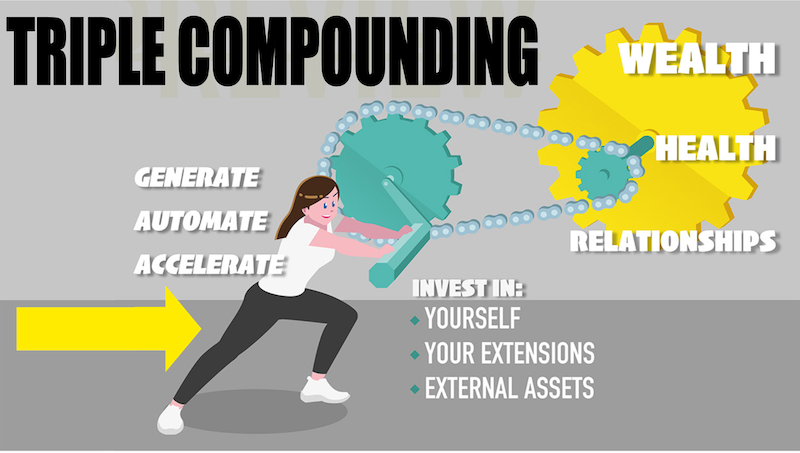
Instead of concentrating only on the money you invest, Triple Compounding looks at three connected investments:
- Yourself
- Your extensions
- Your external assets
This broader approach is the key to understanding Why is Triple Compounding better than traditional investing for someone who wants to develop more than an investment portfolio.
It recognizes that your financial future may be influenced not only by the returns your investments generate, but also by your knowledge, skills, earning potential, systems, decisions, and ability to create new opportunities.
Rather than replacing traditional investing, Triple Compounding places it inside a much larger framework for long-term growth.
Why Is Triple Compounding Better Than Traditional Investing? The Quick Answer
Why is Triple Compounding better than traditional investing?
The simple answer is that traditional investing primarily focuses on growing financial assets, while Triple Compounding aims to grow three interconnected areas at the same time: yourself, your income-generating extensions, and your external assets.
The process can be summarized like this:
Invest in yourself → strengthen your extensions → invest in external assets → reinvest the results → repeat
Triple Compounding then applies three actions across each level:
Generate → Automate → Accelerate
This means you are not relying solely on the performance of an investment portfolio to create progress.
You are also developing the person making the decisions, strengthening your ability to generate income, and building systems that can potentially create more resources to invest.
That creates several possible engines of growth instead of only one.
You can explore the complete structure in The Triple Compounding Framework Explained.
What Is Traditional Investing?
Before explaining Why is Triple Compounding better than traditional investing, it is important to understand what traditional investing does well.
Traditional investing generally involves putting money into external assets with the expectation that they may generate income, appreciate in value, or both.
These external assets might include:
- Stocks
- Real estate
- Cryptocurrency
- Private investments
- Other income-producing or appreciating assets
The basic compounding process is:
- Invest money.
- Potentially earn a return.
- Reinvest some or all of that return.
- Allow the investment and accumulated returns the opportunity to grow over time.
Traditional financial compounding remains an important element of long-term wealth building.
Triple Compounding does not argue against this principle.
Instead, it asks a bigger question:
What if money is not the only thing that can compound?
What Is Triple Compounding?
Triple Compounding is a framework created by Kiana Danial, founder and CEO of Invest Diva.
It expands the concept of compounding beyond financial assets.
Within the framework, there are three investments:
1. Yourself
This includes your:
- Knowledge
- Financial literacy
- Skills
- Personal development
- Decision-making ability
- Emotional intelligence
- Confidence
- Leadership abilities
- Understanding of financial risk
- Health and personal performance
2. Your Extensions
Your extensions are the ways your abilities create value outside of you.
They may include:
- Your career
- Your profession
- Your business
- Your personal brand
- Your products or services
- Your systems
- Your professional network
- Your income streams
- Other income-generating activities
3. Your External Assets
These are the investments traditionally associated with building wealth, including stocks, real estate, cryptocurrency, private investments, and other assets that may appreciate or generate income.
The important difference is that Triple Compounding connects all three.
Your personal development may strengthen your income-producing abilities.
Greater earning capacity may give you additional resources to invest.
Your external investments may potentially generate returns that can then be reinvested into yourself, your extensions, or further external assets.
That creates a cycle.
For a detailed explanation of how the three investments work together, read How To Build Wealth With Triple Compounding.
Traditional Investing vs Triple Compounding
The difference becomes easier to understand when the two approaches are compared directly.
| Traditional Investing | Triple Compounding |
|---|---|
| Primarily focuses on financial assets | Focuses on yourself, your extensions, and your external assets |
| Usually starts with money available to invest | Starts by developing the person responsible for creating, managing, and investing money |
| Compounds financial capital | Seeks to compound knowledge, skills, earning ability, systems, and financial capital |
| Main growth engine is generally the external investment | Creates several potential growth engines |
| Focuses heavily on investment returns | Also considers earning capacity and the source of investment capital |
| May treat personal development separately from investing | Connects personal development with income generation and investing |
| Reinvests financial returns | Can reinvest resources across education, systems, income generation, and financial assets |
| Primarily considers financial wealth | The broader framework also recognizes wealth, health, and relationships |
Traditional investing remains contained within Triple Compounding.
The difference is that it becomes one part of the system rather than the entire system.
This is central to understanding Why is Triple Compounding better than traditional investing as a broader approach to creating long-term growth.
1. Triple Compounding Starts With You
One of the biggest differences between Triple Compounding and traditional investing is where the process begins.
Traditional investing commonly starts with a question such as:
What should I invest my money in?
Triple Compounding starts earlier.
It asks:
Who is making that investment decision, and how can that person become better equipped to make it?
This is important because every investment decision is influenced by the person making it.
Your financial knowledge may affect what you understand.
Your ability to assess risk may influence the investments you consider.
Your emotions may affect how you respond when markets rise or fall.
Your skills may influence your earning potential.
Your financial habits may determine whether you invest consistently.
Your ability to recognize opportunities may affect your future income.
An investment cannot develop these qualities for you.
Triple Compounding therefore treats personal development as part of the wealth-building process rather than something separate from it.
You develop the person who will eventually choose, manage, and build the assets.
2. Triple Compounding Focuses on Growing Your Ability to Earn
This is another major reason Why is Triple Compounding better than traditional investing when viewed as a complete wealth-building framework.
Traditional investment growth depends partly on the capital you have available to invest.
But where does that capital come from?
Usually, it first has to be earned.
Triple Compounding explicitly considers this stage through your extensions.
Imagine you develop a valuable new skill.
That is an investment in yourself.
You then use that skill to improve your performance at work, advance your career, provide a valuable service, or develop a business.
That is an investment in your extensions.
If those improvements lead to greater income, you may have additional resources available to invest into external assets.
The framework therefore connects:
Knowledge → skills → value → income → investing
Rather than looking only at how effectively existing money can grow, Triple Compounding also considers how your ability to produce investable money may grow.
That distinction can be extremely important over the long term.
3. Triple Compounding Creates Multiple Growth Engines
Traditional investing generally relies heavily on one principal growth engine: the performance of your external assets.
Triple Compounding introduces several potential growth engines.
For example:
- Your knowledge can grow.
- Your skills can improve.
- Your earning ability can increase.
- Your career can progress.
- Your business can develop.
- Your systems can become more efficient.
- Your professional network can expand.
- Your investment contributions may increase.
- Your external assets may grow.
- Your investment income may be reinvested.
These areas do not necessarily develop at the same rate, nor does progress in one guarantee progress in another.
But they can support each other.
Better knowledge may contribute to more informed financial decisions.
More valuable skills may strengthen earning potential.
Greater income may increase the amount available to invest.
Better systems may make productive actions easier to repeat.
External investment returns may provide additional resources that can be reinvested.
Instead of attempting to create growth through only one channel, Triple Compounding connects several channels.
This concept is explored further in What Makes Triple Compounding Different?.
4. Triple Compounding Does Not Wait Until You Have Significant Money
Many people assume wealth building begins when they finally have enough money to invest.
Triple Compounding begins earlier.
You can begin by improving your financial knowledge.
You can develop a valuable skill.
You can improve your professional abilities.
You can build more productive habits.
You can strengthen an existing income-generating activity.
You can create systems that improve consistency.
You can learn how investments and financial risk work before committing significant capital.
This does not mean that building external financial assets requires no money.
It means that the Triple Compounding process itself does not have to begin with a large investment account.
Your first investment is yourself.
This can make the framework particularly relevant to beginners who are still developing their income, knowledge, and investable capital.
For a practical starting point, see How To Start Triple Compounding in 2026.
5. Triple Compounding Connects Personal Growth With Financial Results
Personal development and financial investing are often discussed separately.
Triple Compounding intentionally connects them.
Learning alone is not enough.
You need a way to turn knowledge into something useful.
Suppose you spend time developing a new professional skill.
Under Triple Compounding, the process does not finish when you acquire the skill.
The next questions become:
How can you apply it?
How can it create value?
Can it improve your career?
Can it increase your income?
Can it strengthen a business?
Can it become part of a repeatable system?
Can some of the additional income eventually be invested?
This is where your extensions become important.
They provide the bridge between who you are becoming and the financial results you may be capable of producing.
Triple Compounding therefore does not treat self-improvement as an isolated goal.
It connects personal development to action, income generation, systems, and eventually external assets.
6. Triple Compounding Uses Generate, Automate and Accelerate
Another important answer to Why is Triple Compounding better than traditional investing is that the framework provides a repeatable process across all three investment levels.
The three actions are:
Generate
Before anything can compound, something valuable must first be created.
At the personal level, you might generate:
- Knowledge
- Skills
- Better habits
- Greater financial understanding
Through your extensions, you might generate:
- Income
- A valuable service
- A business
- Professional opportunities
- New systems
Through external assets, you may seek to generate:
- Potential investment returns
- Income
- Cash flow
- Capital appreciation
There has to be something worth compounding before compounding can begin.
Automate
The second stage is about making productive actions more consistent and repeatable.
You might automate or systemize:
- Financial education
- Regular financial reviews
- Productive personal habits
- Business processes
- Income-generating activities
- Investment contributions
- Portfolio reviews
- Reinvestment processes
Automation does not necessarily mean removing yourself from the process.
It means reducing unnecessary reliance on memory, motivation, or spontaneous decisions.
A good action performed once may help once.
A good process repeated consistently has the potential to create much greater long-term impact.
Accelerate
Once something is producing useful results consistently, the next stage is to strengthen or expand it.
Acceleration might involve:
- Developing more advanced skills
- Improving technology
- Expanding successful systems
- Reinvesting profits
- Strengthening a team
- Developing strategic relationships
- Increasing investment contributions when appropriate
- Reinvesting investment income or returns
The order matters:
Generate first. Automate second. Accelerate third.
Triple Compounding is not about scaling everything as quickly as possible.
The principle is to create something useful, make it repeatable, then build upon what is already working.
7. Triple Compounding Creates a Self-Reinforcing Cycle
Perhaps the clearest explanation of Why is Triple Compounding better than traditional investing is the cycle created when all three investments begin working together.
Step 1: Invest in Yourself
Develop your financial knowledge, skills, decision-making ability, and personal capabilities.
Step 2: Strengthen Your Extensions
Apply those capabilities through your job, career, profession, business, personal brand, service, or another income-generating activity.
Step 3: Invest in External Assets
Direct an appropriate part of the money you generate into researched investments that fit your circumstances, objectives, and tolerance for risk.
Step 4: Reinvest the Results
Resources generated through the process can potentially be reinvested into:
- Further education
- Better skills
- Improved technology
- Stronger systems
- Business development
- Health and personal performance
- Additional external assets
Then the cycle begins again.
Personal growth may support income growth.
Income growth may support investment growth.
Investment growth may create resources for further personal, professional, or financial growth.
This interconnected loop is the essence of Triple Compounding.
8. Triple Compounding Can Reduce Dependence on a Single Source of Progress
Relying on one source of financial progress can create limitations.
Someone might depend entirely on:
- Their salary
- Their business
- One investment
- Investment market performance
- A single income stream
Triple Compounding encourages a wider view.
The aim is not necessarily to create dozens of investments or businesses.
Instead, the framework helps you recognize that progress can come from several interconnected areas.
You can strengthen yourself.
You can strengthen your ability to generate income.
You can develop systems.
You can build external assets.
If one area develops slowly, another area may still be improving.
An investment portfolio may temporarily fall in value while your professional skills are developing.
Your career may temporarily grow slowly while your financial knowledge improves.
Your external assets may generate returns that can be invested back into other areas.
This does not eliminate risk.
But it creates a broader foundation than relying exclusively on one source of progress.
9. Triple Compounding Includes Traditional Investing Rather Than Rejecting It
There is an important distinction to make.
Asking Why is Triple Compounding better than traditional investing does not mean traditional investing is bad.
Traditional investing is actually the third investment within Triple Compounding: external assets.
The difference is context.
Traditional investing might ask:
How can I make my invested money grow?
Triple Compounding asks:
How can I grow myself, strengthen the ways I generate income, and build external assets so that all three can support one another?
External investing still matters.
Reinvestment still matters.
Compound growth still matters.
Asset selection and risk still matter.
The difference is that they exist within a wider system.
Triple Compounding therefore expands traditional investing rather than attempting to replace it.
10. Triple Compounding Considers the Source of Your Investment Capital
This point is easy to overlook.
Imagine two people each invest the same amount of money today.
One focuses solely on managing that investment.
The other also works on increasing their knowledge, developing valuable skills, strengthening their career or business, and improving the systems through which they generate income.
If the second person eventually becomes capable of consistently investing more money, the difference is not solely caused by investment performance.
It may also be influenced by growth in earning capacity.
This demonstrates an important principle.
Your eventual investment portfolio can be influenced by two broad factors:
How effectively the money already invested grows
and
How much additional capital you are capable of investing over time
Traditional investing tends to emphasize the first.
Triple Compounding explicitly considers both.
11. Triple Compounding Builds the Investor, Not Just the Portfolio
Financial assets do not make decisions.
People do.
Your ability to understand risk, remain patient, follow a process, and avoid purely emotional decisions can influence your behavior as an investor.
That is why financial education sits within the first level of Triple Compounding.
The objective is not merely to own investments.
It is to develop the knowledge and capabilities required to approach those investments responsibly.
As your understanding develops, you may become better equipped to ask questions such as:
- What am I investing in?
- Why am I investing in it?
- What risks are involved?
- How does it fit my wider objectives?
- What could affect its performance?
- How much risk am I prepared and able to accept?
- Am I following a process or reacting emotionally?
Triple Compounding therefore puts significant emphasis on developing the investor before attempting to accelerate the investments.
12. Triple Compounding Goes Beyond Financial Wealth
Another important difference is that the complete Triple Compounding framework does not define success entirely through money.
It also recognizes three interconnected areas:
Wealth
Financial resources can provide choice, freedom, and opportunities for future growth.
Health
Physical and mental wellbeing can influence your energy, focus, productivity, performance, and quality of life.
Relationships
Personal and professional relationships can contribute to support, opportunity, happiness, and fulfillment.
These areas can affect each other.
Financial wealth may mean little if poor health prevents you from enjoying it.
Professional success may feel incomplete when important relationships are neglected.
Poor health may affect your capacity to work, learn, or make good decisions.
Strong relationships may provide support, knowledge, and opportunities.
Triple Compounding therefore views long-term success more broadly than the size of an investment account.
This wider relationship between financial progress and freedom is explored in How Triple Compounding Accelerates Financial Freedom.
A Simple Example of Triple Compounding vs Traditional Investing
Imagine two people who both begin by investing $500 per month into external assets.
Investor One: Traditional Investing
Investor One:
- Invests $500 each month.
- Follows an investment strategy.
- Reinvests potential returns.
- Continues investing over time.
There is nothing inherently wrong with this approach.
They are using traditional financial compounding.
Investor Two: Triple Compounding
Investor Two also invests $500 per month.
But at the same time, they:
- Improve their financial knowledge.
- Develop a valuable professional skill.
- Use that skill to strengthen their earning capacity.
- Create systems that make their work more efficient.
- Build stronger financial habits.
- Increase their income.
- Direct part of that additional income into investments.
- Reinvest potential investment returns.
- Continue developing themselves and their income-generating abilities.
Both individuals still participate in traditional investment compounding.
The difference is that Investor Two is also attempting to compound their:
- Knowledge
- Skills
- Earning ability
- Income
- Systems
- Opportunities
- External investments
This example captures the central answer to Why is Triple Compounding better than traditional investing as a broader framework.
It does not rely solely on making the original $500 investment work harder.
It also considers how the person may become capable of creating more value and investing more resources over time.
Is Triple Compounding Better Than Traditional Investing for Beginners?
Triple Compounding can be particularly useful as an educational framework for beginners because it does not suggest that your first task must be finding the perfect stock, property, or cryptocurrency.
You can begin by understanding:
- How money works
- How investing works
- What financial risk means
- What skills you already possess
- Which skills could strengthen your earning potential
- Where your income currently comes from
- How your financial habits could improve
- How external assets fit into a wider financial strategy
A beginner may therefore develop the foundation before committing significant money.
This is one reason the answer to Why is Triple Compounding better than traditional investing can depend on what you are trying to achieve.
If the objective is simply to describe how invested financial capital compounds, traditional compounding already explains that extremely well.
If the objective is to understand how personal development, earning capacity, and investment capital might be developed together, Triple Compounding provides a broader framework.
Do You Need a Business to Use Triple Compounding?
No.
Your extensions do not have to be a business.
They could include:
- Your employment
- Your career
- Your profession
- Freelance work
- Your personal brand
- A service
- A side income
- Another income-generating activity
An employee can invest in themselves by developing professional skills.
They can use those skills to improve their career.
They can strengthen their earning capacity.
They can build better financial systems.
They can invest part of their income into external assets.
Entrepreneurship can fit within Triple Compounding, but it is not a requirement.
Is Triple Compounding a Get-Rich-Quick Strategy?
No.
Triple Compounding is not based on finding a shortcut to wealth.
It is built around long-term principles including:
- Learning
- Skill development
- Creating value
- Generating income
- Building systems
- Investing
- Reinvesting
- Consistent action
- Responsible decision-making
External investments involve risk, and positive returns are never guaranteed.
Developing new skills does not guarantee higher income.
Building systems does not guarantee business success.
Triple Compounding provides a framework for connecting these activities.
It does not eliminate uncertainty or promise a specific financial outcome.
Why Is Triple Compounding Better Than Traditional Investing for Long-Term Wealth Building?
The strongest argument is not that financial compounding somehow stops working.
It is that financial compounding may become even more useful when supported by other forms of growth.
Consider the sequence:
Better knowledge → potentially better decisions
Better skills → potentially greater earning capacity
Greater earning capacity → potentially more investable capital
More investable capital → greater opportunity to build external assets
External asset growth → potential resources for further investment
Better systems → greater consistency across the entire process
Triple Compounding connects these relationships instead of viewing them as unrelated activities.
That is why the framework is broader than traditional investing alone.
The Biggest Difference Between Triple Compounding and Traditional Investing
If you remember only one distinction, make it this:
Traditional investing asks how your money can compound.
Triple Compounding asks how you, your ability to generate income, and your money can compound together.
That difference changes where the wealth-building process begins.
It begins before you purchase an investment.
It begins with developing knowledge.
It continues through building valuable skills.
Those skills can strengthen your extensions.
Your extensions may generate income.
Some of that income can be invested into external assets.
Potential results can then be reinvested into further growth.
That creates a continuing cycle rather than a single compounding process.
Frequently Asked Questions About Why Triple Compounding Is Better Than Traditional Investing
Why is Triple Compounding better than traditional investing?
Triple Compounding provides a broader framework because it does not focus only on financial assets. It combines investing in yourself, your income-generating extensions, and external assets so that personal growth, income growth, and investment growth can potentially support one another over time.
What is the biggest difference between Triple Compounding and traditional investing?
Traditional investing primarily focuses on growing financial capital through external assets. Triple Compounding also focuses on developing your knowledge, skills, earning capacity, and systems before connecting those areas with external investing.
Does Triple Compounding replace traditional investing?
No. Traditional investing is incorporated into Triple Compounding through the third investment level, external assets. Triple Compounding expands the process by connecting those assets with personal development and income generation.
What are the three investments in Triple Compounding?
The three investments are yourself, your extensions, and your external assets. Yourself includes knowledge, skills, and personal development. Extensions include your career, profession, business, personal brand, systems, and income-generating activities. External assets include investments such as stocks, real estate, cryptocurrency, and other potential income-producing or appreciating assets.
What are Generate, Automate and Accelerate?
Generate means creating something valuable. Automate means creating a consistent and repeatable process. Accelerate means increasing the scale, speed, or impact of a process that is already working.
Why does Triple Compounding begin with investing in yourself?
Because you are responsible for the financial, career, and investment decisions that follow. Developing your financial knowledge, skills, and decision-making abilities can provide a stronger foundation for your extensions and external investments.
Can Triple Compounding help someone who does not have much money to invest?
The framework can begin before someone has substantial investment capital because the first investment is yourself. A person can begin by improving financial literacy, developing valuable skills, strengthening their earning ability, and creating better financial habits before gradually building external assets.
Is Triple Compounding only for entrepreneurs?
No. Extensions can include employment, a career, a profession, freelance work, a personal brand, or other income-generating activities. Business ownership is only one possible extension.
Does Triple Compounding guarantee better investment returns?
No. Triple Compounding does not guarantee investment returns, financial success, or wealth. External investments involve risk. The framework provides a structure for connecting personal development, income generation, systems, and investing.
Is Triple Compounding a get-rich-quick system?
No. Triple Compounding is a long-term framework based on learning, creating value, developing income, building systems, investing, and reinvesting. It requires time, action, education, and informed decision-making.
Key Takeaways: Why Is Triple Compounding Better Than Traditional Investing?
So, Why is Triple Compounding better than traditional investing as a broader wealth-building framework?
The key differences are:
- Triple Compounding aims to compound more than money.
- It starts with investing in yourself.
- It develops your knowledge and financial understanding.
- It connects skills with income-generating extensions.
- It considers your ability to generate investment capital as well as the performance of that capital.
- It includes traditional external investing rather than replacing it.
- It creates several potential growth engines.
- It applies Generate, Automate, and Accelerate throughout the framework.
- It encourages reinvestment across yourself, your extensions, and your external assets.
- It recognizes the wider importance of wealth, health, and relationships.
- It is designed as a long-term framework rather than a get-rich-quick strategy.
Final Thoughts: Why Is Triple Compounding Better Than Traditional Investing?
Traditional investing remains one of the fundamental ways people can attempt to grow financial wealth over time.
Triple Compounding simply starts from a broader perspective.
Money is not the only resource capable of development.
Your knowledge can grow.
Your skills can improve.
Your earning ability can increase.
Your systems can become stronger.
Your financial understanding can develop.
Your external assets can potentially appreciate or produce income.
And the resources generated by one area can potentially help strengthen another.
This is the real answer to Why is Triple Compounding better than traditional investing for someone looking for a more comprehensive approach to long-term growth.
Traditional investing focuses primarily on putting your money to work.
Triple Compounding focuses on developing yourself, strengthening the ways you create income, and putting your money to work together.
That is the power of creating more than one compounding engine.
To understand the complete philosophy and how the three investments fit together, read The Triple Compounding Framework Explained.
You can also explore How To Build Wealth With Triple Compounding or learn How To Start Triple Compounding in 2026. 👇

Disclosure: I am not a financial advisor, and this blog post is not financial advice. This information is shared for educational purposes only. This post about “Why Is Triple Compounding Better Than Traditional Investing” may contain affiliate links, meaning I may receive a commission if you decide to make a purchase through those links, at no additional cost to you. Please see the terms of service for more information.

#1 Best Selling Author. Helping you accelerate your retirement with Triple Compounding™ Former engineer on a mission to help 1 million households take control of their finances. Founder & CEO of Invest Diva.
Leave a Reply