

Building substantial wealth involves more than investing the money you already have. It also involves developing your ability to earn, creating consistent financial habits, and putting resources back into the areas that support your progress.
Triple Compounding™ brings these parts together.
The framework connects three investments: yourself, your extensions, and your external assets. It then applies Generate, Automate, and Accelerate across all three.
The idea is simple: develop your capabilities, use them to create income, and invest an appropriate share of that income. Build systems around those activities, then reinvest resources to continue growing.
When your ambition is generational wealth, the goal is to build substantial, lasting financial resources that could benefit future generations if you choose.
This guide explains how to build generational wealth with Triple Compounding, with practical examples of how each part of the framework works.
How To Build Generational Wealth With Triple Compounding? The Quick Answer
To pursue generational wealth with Triple Compounding, develop your knowledge and skills, use them through your career or business to generate income, and invest an appropriate portion of that income into external assets.
Apply Generate, Automate, and Accelerate across these areas, then reinvest resources to continue the process. Building substantial wealth is the ambition, not a guaranteed result.
What Does Generational Wealth Mean Here?
Generational wealth means financial resources that can benefit more than one generation.
The focus here is on building those resources. Before you can think about passing wealth on, you need to create it.
That means looking beyond a single paycheck or investment result. You are working toward a stronger financial position over time, with the possibility of building more than you need for your own lifetime.
There is no universal amount that defines generational wealth. Your circumstances and goals will influence what substantial wealth means to you.
The practical starting point is understanding how you can develop yourself, strengthen your income-generating activities, and build investments together.
What Is Triple Compounding?
Triple Compounding is a framework created by Kiana Danial, founder and CEO of Invest Diva.
It connects three investment levels:
| Investment level | What you develop |
|---|---|
| Yourself | Knowledge, skills, judgment, and personal capabilities |
| Your extensions | Your career, business, profession, and other income-generating activities |
| Your external assets | Investments outside your personal abilities and daily work |
Across each level, you apply:
- Generate: Create something valuable.
- Automate: Make useful actions consistent and repeatable.
- Accelerate: Expand what is working.
For the original explanation, read The Triple Compounding Framework Explained.
Why Look Beyond Traditional Compounding?
Traditional financial compounding happens when investment returns are reinvested and have the opportunity to contribute to further growth.
Triple Compounding keeps financial investing within a broader picture.
Before you can invest money, you need resources available to invest. Your work, capabilities, and financial decisions all influence that process.
Consider the difference between these three activities:
- Learning a professional skill.
- Using that skill through your work.
- Investing part of the income you earn.
They are connected, but they are not the same activity.
The first develops your capabilities. The second applies them. The third builds financial investments.
Understanding these connections helps explain why the framework includes more than an investment account.
1. Invest in Yourself: Build the Foundation
The first investment level is yourself.
This includes developing financial literacy, professional knowledge, useful skills, and the judgment needed to make decisions.
You remain the person responsible for choosing opportunities, understanding commitments, and deciding what to do next.
Generate: Develop Useful Knowledge and Skills
At this level, Generate means building capabilities.
Examples include learning how financial markets work, improving a professional skill, developing communication abilities, and understanding your tolerance for financial risk.
Give the education a clear purpose.
If you are studying an investment, understand what it is and how it works. If you are developing a professional skill, know where it could be used.
You do not need to assume that every course or qualification will produce a financial return.
Automate: Make Personal Development Consistent
Automation here means establishing routines.
Schedule time for financial education. Set a recurring time to review your finances. Make progress toward your goals something you revisit.
A routine should tell you what you intend to do and when.
The purpose is to give important activities a consistent place in your life, rather than leave them dependent on whether you happen to remember them.
Accelerate: Build on Useful Capabilities
Once you have a foundation, you can explore more advanced education, experienced teachers, structured support, and practical application.
Be clear about what the additional commitment is meant to accomplish.
Completing introductory material and being ready for advanced work are different things. Establish the connection before moving on.
2. Invest in Your Extensions: Turn Capabilities Into Income-Generating Activity
Your extensions are the ways your capabilities create value and potential income.
They can include your job, profession, business, personal brand, services, and other active-income activities.
Business ownership is optional. Employment and professional work are also part of the framework, as explained in How To Build Wealth With Triple Compounding.
Generate: Apply Your Abilities Through Work
Generation at this level concerns creating value through what you do.
Examples include improving your performance at work, providing a service, developing a product, or building a business.
The distinction from personal development is application.
Learning a skill concerns your capabilities. Using it to handle responsibilities or serve customers concerns your extensions.
Before pursuing an opportunity, be clear about the work involved and the abilities it requires.
Automate: Establish Repeatable Work Processes
Automation can include documented business procedures, technology for routine work, customer-service systems, and appropriate delegation.
Start with something you do repeatedly.
Describe the steps, the information required, and the circumstances that need additional attention.
A process should be understandable to the person carrying it out. Technology alone does not explain what should happen or who remains responsible.
For an employee or professional, a repeatable process can also bring structure to recurring responsibilities.
Accelerate: Expand Activities With an Established Basis
Examples include expanding a proven service, improving successful systems, developing a team, and reinvesting business profits.
Before expanding, identify what supports the decision.
What have you observed? What commitments would expansion involve? Which uncertainties remain?
Separate the result you have already seen from the outcome you hope expansion will produce.
A large wealth goal does not, by itself, make every business or career opportunity suitable.
3. Invest in External Assets: Build Financial Investments
External assets are investments outside your personal capabilities and daily work.
The framework includes assets with the potential to produce income or appreciate in value. Investments involve risk, and returns are not guaranteed.
This level concerns committing money to financial investments rather than developing your own capabilities or working activities.
Generate: Acquire Assets With Return Potential
Generation here means building or acquiring investments that may produce financial results.
The important word is “may.”
Buying an investment is an action you can take. Receiving a positive return is an uncertain outcome.
Understand what you would own, why you are considering it, and what could affect its performance.
Automate: Establish a Structured Investment Process
Examples include regular contributions, scheduled portfolio reviews, predetermined investment criteria, and reinvestment of income or dividends where appropriate.
Be clear about what the process does.
A recurring contribution and a portfolio review serve different purposes. One commits money; the other involves examining your investments.
Automation does not mean removing oversight or assuming the result will be positive.
Accelerate: Reinvest and Increase Contributions When Appropriate
Acceleration may involve reinvesting returns or increasing contributions as your income and circumstances allow.
It should not be treated as an instruction to take uncontrolled risks.
Explain why an additional commitment fits your situation. Wanting to build wealth more quickly does not remove the need to understand the investment.
For more detail on these applications, read How To Build Wealth With Triple Compounding.
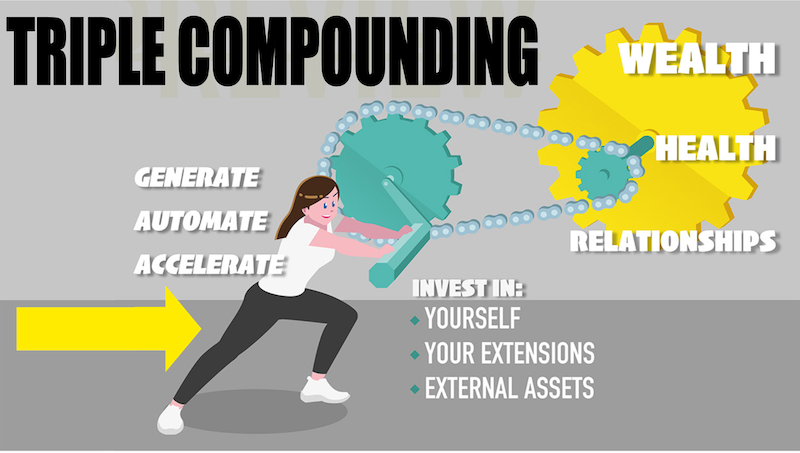
How the Three Levels Work Together
The framework connects personal development, income-generating activity, and external investing. Resources can then be reinvested across those areas.
Look at the connections in your own circumstances.
If you develop a capability, where do you intend to apply it?
If you consider a career or business opportunity, what does it require?
If you are evaluating an investment, what do you need to understand before committing money?
You do not need to claim that every connection guarantees a gain. You do need to distinguish a clear relationship from an assumption.
For example, professional education may be relevant to work you already do. That relevance does not establish a particular future income.
Keep the reasoning and the eventual result separate.
Why Reinvestment Matters to the Framework
The original articles describe resources being directed back into education, income-generating activities, and investments.
This makes reinvestment a broader question than what happens inside an investment account.
When resources become available, you have a decision about their use.
The framework identifies several areas to consider. It does not establish that one option will always be best.
Compare the purpose of each possible commitment. Be clear about what you expect it to accomplish and what remains uncertain.
Avoid assuming that repeating a past decision will necessarily repeat its result.
Where Does the Generational Wealth Goal Fit?
Generational wealth describes the scale and lasting value of what you hope to build.
It gives the process a long-term purpose. It does not change the need to understand each commitment.
“I want to build wealth that could benefit future generations” explains your ambition.
“This is why I am taking this action, and these are its uncertainties” explains the immediate decision.
Both deserve attention.
When exploring how to build generational wealth with Triple Compounding, keep the long-term goal in view while remaining specific about what you are doing today.
Wealth, Health, and Relationships
The framework’s broader perspective includes health and relationships alongside financial wealth.
Keep that wider perspective in mind when defining your own ambitions.
What do you want your financial resources to make possible? Which commitments are you willing to make? What do you want to preserve while pursuing the goal?
A financial target does not answer those questions for you.
Your circumstances and priorities still need a place in the approach.
Frequently Asked Questions
How To Build Generational Wealth With Triple Compounding?
Use the three investment levels and Generate, Automate, and Accelerate to organize your wealth-building efforts. Assess individual decisions according to your understanding, circumstances, and the risks involved, while maintaining your long-term ambition.
Does Triple Compounding Mean Tripling Your Money?
No. The name refers to the framework’s three connected investment levels. It is not a promise to triple an investment or achieve a particular return.
Do You Need to Own a Business?
No. Employment and professional work are included within the framework’s description of extensions.
Can You Begin Before You Have Substantial Money to Invest?
You can begin by developing your understanding. Starting with education does not require committing money to an unfamiliar financial investment.
How Long Does It Take to Build Generational Wealth?
There is no universal timetable. The framework does not establish a guaranteed period for reaching that outcome.
Does Triple Compounding Guarantee Wealth?
No. It provides a structure for approaching wealth building, not a guaranteed financial result.
Build With a Long-Term Purpose
Understanding how to build generational wealth with Triple Compounding means considering your capabilities, your income-generating activities, and your investments together.
Look at how those areas connect in your circumstances.
What do you need to understand? Where can you apply your abilities? Which commitment requires closer examination?
Keep the ambition substantial and the reasoning clear.
For the framework’s foundations, read The Triple Compounding Framework Explained and How To Build Wealth With Triple Compounding.

Disclosure: I am not a financial advisor, and this blog post is not financial advice. This information is shared for educational purposes only. This post about “how to build generational wealth with triple compounding may contain affiliate links, meaning I get a commission if you decide to make a purchase through my links, at no cost to you. Please see the terms of service page for more information.

#1 Best Selling Author. Helping you accelerate your retirement with Triple Compounding™ Former engineer on a mission to help 1 million households take control of their finances. Founder & CEO of Invest Diva.
Leave a Reply