
The 7 Habits Of Successful Triple Compounders connect three important parts of building wealth: what you learn, how you earn, and how you invest. They also recognize that your health and relationships matter alongside your finances.
These habits come from Kiana Danial’s Triple Compounding™ framework.
The idea is simple. Improving your knowledge and skills can help you make better decisions and create more value through your work. Your income can then provide money for investments. When resources become available, you can put some of them back into learning, your work, or additional investments.
Each part can help the others.
Before exploring the seven habits, let’s explain what Triple Compounding™ means and how it works.
What Is Triple Compounding?
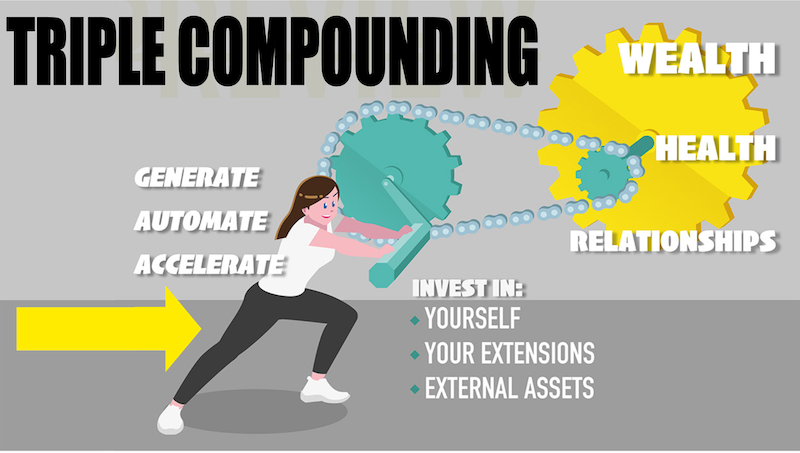
Triple Compounding is a framework that connects investing in yourself, your income-generating extensions, and your external assets. It uses three actions, Generate, Automate, and Accelerate, to help these areas work together over time.
It also takes a broad view of success by including wealth, health, and relationships.
Some of those terms may be new to you. Here is what they mean:
- Yourself: Your knowledge, skills, judgment, and well-being.
- Your extensions: The ways you use your skills to create value and earn income, such as your job or business.
- Your external assets: Investments outside your own skills and daily work, such as stocks or real estate.
The framework connects these three areas because your financial life involves all of them.
Your skills can affect your income. Your income can affect how much money you have available to invest. Your financial knowledge can affect how you approach investment decisions.
Triple Compounding brings those connections into one clear structure.
How Traditional Compounding Works
Traditional financial compounding starts with money.
You invest, earn potential returns, and reinvest those returns. Your original investment and its accumulated returns then have the chance to produce further growth.
Triple Compounding includes this process. It also considers what helps you earn, invest, and make informed decisions in the first place.
Before money reaches an investment account, there is usually work, income, and a decision about how to use it. Behind that decision is your knowledge and understanding of risk.
Those parts of your financial life matter too.
How the Three Areas Can Help Each Other
The basic Triple Compounding cycle is:
Develop yourself → strengthen your income-generating extensions → invest in external assets → reinvest the results.
You begin by building knowledge and useful skills.
You apply those skills through your career, profession, business, or other work.
Income may then provide money for external investments.
When profits or investment returns become available, they may support further learning, better systems, or additional investments.
These are possible connections, rather than guaranteed results. Learning a skill does not guarantee higher income, and investing does not guarantee a profit.
The framework explains how the different areas can support each other.
The Three Investments in Triple Compounding
The 7 Habits Of Successful Triple Compounders build on three types of investment. Understanding each one makes the habits easier to follow.
1. Investing in Yourself
Investing in yourself means developing the knowledge and skills you bring to your decisions.
This can include:
- Learning about money and investing.
- Improving professional skills.
- Building leadership and communication skills.
- Developing emotional intelligence.
- Strengthening personal discipline.
- Learning how to understand financial risk.
- Supporting your physical and mental well-being.
You use these skills in different parts of your life.
Financial knowledge helps you understand an investment. Professional skills help you do your work. Communication helps you work with other people.
You remain the person making the decisions. That is why the framework starts with you.
2. Investing in Your Extensions
Your extensions are the ways you use your knowledge and skills outside yourself.
They may include your:
- Job.
- Career or profession.
- Business.
- Products or services.
- Personal brand.
- Professional network.
- Systems.
- Other income-generating activities.
Learning a useful skill is an investment in yourself. Applying that skill through your work is an investment in an extension.
You do not need to own a business. A job, profession, or freelance service can also be an extension.
The important point is how your skills create value and may help you earn income.
3. Investing in External Assets
External assets are investments outside your own skills and daily work.
Examples within the framework include stocks, real estate, cryptocurrencies, and private investments.
Depending on the asset and its performance, an investment may grow in value, produce income, or pay dividends. It can also lose value.
These examples are different types of investments. They are not a recommendation that everyone should own all of them.
Your knowledge, goals, financial situation, and understanding of risk remain important.
For the full introduction to these three investments, read The Triple Compounding Framework Explained.
Generate, Automate, and Accelerate: What Do They Mean?
Triple Compounding applies the same three actions to yourself, your extensions, and your external assets.
Generate: Create Something Useful
Generate means creating something valuable.
Within yourself, that may mean learning something or developing a skill.
Through your extensions, it means using your skills to create value and potentially earn income.
For external assets, it means building or buying investments that may produce returns.
This is the starting point. Something useful needs to exist before you can repeat it or expand it.
Automate: Make Useful Actions More Consistent
Automate means creating habits, routines, and systems that make useful actions easier to repeat.
This can include scheduled learning, regular financial reviews, business processes, and structured investment decisions.
Technology may help, but automation also includes routines you follow yourself.
The aim is to make important actions less dependent on memory or how motivated you feel.
Accelerate: Build on What Is Working
Accelerate means increasing the speed, scale, or impact of something that is already working.
This may involve advanced learning, better technology, stronger systems, partnerships, or reinvestment.
The order matters:
Generate first. Automate second. Accelerate third.
We will explore why that order matters in habit five.
What Are the 7 Habits Of Successful Triple Compounders?
The seven habits are:
- Invest in yourself first.
- Apply your knowledge through your income-generating extensions.
- Build consistent habits and repeatable systems.
- Understand external assets before investing.
- Generate first, automate second, and accelerate third.
- Reinvest resources to support further growth.
- Pursue progress in wealth, health, and relationships.
These habits bring together the practices described in the Triple Compounding framework. They explain how its principles fit together, without promising a particular financial result.
1. Invest in Yourself First
Before deciding what to invest in, consider what you understand about the decision.
Do you know what the investment is? Do you understand its risks? Can you explain why it fits your goals?
These questions bring you back to your own knowledge and judgment.
The first habit is to keep developing the person responsible for those choices.
Learn the Skills Behind Better Decisions
Financial education helps you understand money and investment information.
Professional knowledge helps you provide value through your work.
Communication and emotional intelligence help you work with others.
The framework also includes leadership, confidence, personal discipline, and decision-making skills. Physical and mental well-being are part of this investment too.
These areas can affect more than one decision.
The knowledge you develop may help you assess future opportunities. The skills you improve may support your work. Stronger communication may help in professional relationships.
That is why investing in yourself has a place throughout the framework.
Give Learning a Regular Place in Your Life
Personal development does not always produce an immediate financial result.
Its value may appear through future decisions, responsibilities, and opportunities.
The framework describes making learning more consistent through routines. This can include regular financial education, financial reviews, and a repeatable process for making decisions.
Generate, Automate, and Accelerate apply here too.
You generate knowledge and skills. You make learning more consistent. You then build on useful progress through advanced study, practical experience, educational tools, or support from experienced teachers.
Keep Learning as You Progress
Having a career, business, or investment account does not end the need for personal development.
Further learning can help you understand new responsibilities. More advanced professional skills can support your work. Financial education can deepen your understanding of investments and risk.
You remain involved at every stage.
Investing in yourself comes first because your knowledge and judgment help shape what happens next.
2. Apply Your Knowledge Through Your Income-Generating Extensions
Learning develops your skills. Applying those skills connects them with your work and potential income.
This is where your extensions come in.
Learning a professional skill is an investment in yourself. Using it to improve your work, provide a service, or strengthen a business is an investment in an extension.
The two are connected, but they serve different purposes.
Use What You Know to Create Value
Generating through your extensions means using your abilities to solve problems, improve results, or provide something useful.
Depending on your situation, this may involve:
- Improving your performance at work.
- Developing a useful service.
- Creating a product.
- Taking on more professional responsibility.
- Building a business.
- Growing a personal brand.
- Developing another income-generating activity.
The focus is on how you apply your knowledge.
This explains how personal development may support earning capacity. It does not mean every new skill automatically leads to more income.
Improve How the Work Gets Done
Investing in an extension also includes improving the processes around your work.
This may involve customer-service systems, repeatable procedures, scheduled activities, appropriate delegation, and tracking results.
These processes help organize how value is delivered.
Once an activity produces useful results consistently, you may be able to strengthen it through better technology, partnerships, or expansion of a proven service.
The same three actions apply: create value, make the process more consistent, and then consider how to expand what works.
Remember That Your Job Can Be an Extension
Business ownership is one option within the framework.
Your job, profession, or freelance work can also be a way to use your skills and earn income.
An employee can develop professional skills, apply them at work, strengthen financial processes, and consider how income could support external investing.
The important connection is between what you know, how you use it, and the value it may create.
3. Build Consistent Habits and Repeatable Systems
The third of the 7 Habits Of Successful Triple Compounders focuses on consistency.
Learning, working, and investing all involve useful actions that may need to happen more than once.
Routines and systems give those actions a clear place in your life.
Within Triple Compounding, this is part of automation.
Make Personal Development Easier to Repeat
At the personal level, automation may include:
- Scheduling financial education.
- Creating a routine for reviewing finances.
- Tracking progress toward goals.
- Following a repeatable decision-making process.
- Building healthy behaviors that support energy and focus.
These practices help make useful actions ongoing.
A regular routine can reduce the need to remember every task or wait until you feel motivated.
You still take part in the process. The routine provides structure around the action.
Create Clear Processes in Your Work
Within your extensions, repeatable processes help organize how work gets done.
These may include standard procedures, customer-service processes, scheduled income-generating activities, appropriate delegation, and tracking performance.
A stronger process may reduce unnecessary manual effort and improve consistency.
It may also create more room for further development.
This means your extension includes both the skill used to do the work and the process through which the work gets done.
Keep Financial Automation Under Review
For external assets, a structured process may include regular contributions, set investment criteria, scheduled portfolio reviews, and tracking how money is allocated.
Reinvestment may also be included when appropriate.
Automation does not show that an investment is suitable or guarantee that it will perform well.
You still need to understand what you own, recognize its risks, and consider whether the process fits your financial situation.
The aim is consistency with informed involvement.
4. Understand External Assets Before Investing
External assets may provide returns beyond your direct daily work.
They also involve the possibility of losing money.
This habit connects financial education with the decision to invest.
Before committing money, it is important to understand the asset and your reason for considering it.
Know What You Are Investing In
An informed investment process includes understanding:
- What the investment is.
- Why you are investing.
- The risks involved.
- How it fits your goals.
- What could affect its performance.
- How much risk you are prepared and able to accept.
These questions connect external investing with the first habit.
Financial knowledge helps you understand an opportunity and its place in your financial life.
Popularity alone does not answer those questions. Neither does the fact that an asset appears in a wealth-building framework.
Understand Both the Potential and the Risk
An investment may grow in value or produce income.
It may also lose value.
Stocks, real estate, cryptocurrencies, and private investments are different types of assets. Each needs informed consideration.
The framework does not suggest that every category suits every person. It also does not promise that every investment will produce a profit.
Your knowledge, goals, financial situation, and understanding of risk remain part of the decision.
Follow a Clear Process
Regular contributions, set criteria, and scheduled reviews can support a structured approach.
They do not remove uncertainty.
The same applies when you look for ways to accelerate. Reinvesting income, increasing contributions when appropriate, applying more advanced knowledge, and diversifying through an informed strategy are possible approaches.
These decisions need a sound foundation. Acceleration does not justify uncontrolled risk or investing money you cannot afford to lose.
For more detail, read How To Build Wealth With Triple Compounding.
5. Generate First, Automate Second, and Accelerate Third
The three actions are easy to remember. Their order explains how the framework is meant to develop.
The fifth habit is to follow that order.
It applies whether you are learning, improving an income-generating activity, or developing an investment process.
Each action builds on the one before it.
Start by Creating Something Useful
Within yourself, generation means developing knowledge and skills.
Within your extensions, it means using those skills to create value and potential income.
Within external assets, it means building or buying investments that may produce returns.
This establishes what you are developing.
Before you can make an activity consistent or expand it, there needs to be something useful to work with.
Then Create Consistency
Automation gives that activity a repeatable structure.
A learning routine supports personal development.
A business process supports how value is delivered.
A structured investment approach supports consistency in financial decisions.
At each level, automation reduces dependence on temporary motivation and constant manual effort.
It still requires understanding and oversight.
Build on What Is Already Working
Acceleration comes after a useful activity and a repeatable process have been established.
It may involve advanced education, improved systems, better technology, partnerships, or reinvestment.
For your extensions, this may include expanding a proven service or reaching a larger audience.
For external assets, it may include reinvesting returns or increasing contributions when appropriate.
Trying to accelerate an unproven process may increase waste or risk.
Across the 7 Habits Of Successful Triple Compounders, the order stays the same: create value, build consistency, and then consider how to strengthen the results.
6. Reinvest Resources to Support Further Growth
Reinvestment connects the three investment levels.
The cycle is:
Develop yourself → strengthen your extensions → invest in external assets → reinvest the results.
As resources become available, they may support further learning, stronger systems, or additional investments.
Understand Where Reinvestment Can Go
Reinvestment may support:
- Further education.
- More advanced skills.
- Stronger business systems.
- Health and personal performance.
- Additional income-generating opportunities.
- New or existing external assets.
This means personal development and your work remain part of the cycle after you begin investing.
Resources can support both financial assets and the knowledge or systems involved in creating future value.
See How the Parts Connect
Personal development may help you provide more value.
Applying your skills through an extension may support income generation.
Income may provide money for external investments.
Returns, when achieved, may provide resources for more learning, better systems, or additional assets.
Each connection depends on what happens in practice.
A new skill does not guarantee higher income. A new system does not guarantee business growth. An investment does not guarantee a positive return.
Triple Compounding explains how these areas can support each other without promising a result at every stage.
Keep Reinvestment Appropriate
Reinvestment does not mean putting every available dollar toward growth.
Decisions still depend on your knowledge, goals, financial situation, and tolerance for risk.
Increasing investment contributions is an option when appropriate. Resources may also support health and personal performance.
The habit is to consider how available resources can responsibly support further development.
7. Pursue Progress in Wealth, Health, and Relationships
The final habit brings the wider purpose into focus.
Triple Compounding recognizes wealth, health, and relationships as connected parts of life.
Financial progress matters. So does your ability to benefit from it.
This is why the framework considers more than the value of external assets.
Wealth Supports Opportunities and Goals
Financial resources can support investing, growth, and meaningful choices.
Within Triple Compounding, wealth building connects your knowledge, income-generating activities, systems, and external assets.
It considers the money available to invest alongside the skills and work that support it.
The broader aim includes the opportunities and freedom that financial resources can provide.
Health Affects Daily Life and Performance
Physical and mental well-being affect energy, focus, productivity, longevity, and quality of life.
Health also affects your ability to enjoy financial success.
This explains why it appears both within investing in yourself and within the framework’s wider view of success.
Your well-being matters alongside your knowledge and professional skills.
Relationships Bring Support and Fulfillment
Personal and professional relationships can contribute to support, opportunities, fulfillment, and happiness.
Their importance reaches beyond what money alone can provide.
Emotional intelligence, leadership, and communication are also part of investing in yourself. These skills can influence how you work and connect with other people.
Keep the Whole Picture in View
A person may achieve financial success while struggling with poor health or unfulfilled relationships.
Triple Compounding considers these areas together.
That is why the 7 Habits Of Successful Triple Compounders include financial practices alongside attention to well-being and relationships.
Success has a wider meaning than investment performance.
How the Seven Habits Work Together
Each habit has a role.
Investing in yourself develops knowledge and skills.
Your extensions provide ways to apply them.
Habits and systems support consistency.
Financial education helps you understand external assets.
Generate, Automate, and Accelerate provide the order for developing each area.
Reinvestment allows available resources to support further development.
Wealth, health, and relationships keep the wider purpose in view.
Your starting point may differ from someone else’s.
You may already have a strong career but no consistent investment process. You may own investments while giving less attention to your earning capacity.
The framework brings these areas into one view.
Beginners can start with financial knowledge, useful skills, and an understanding of risk. Someone with more experience may use the framework to connect activities already in place.
The three investments and three actions stay the same. The areas needing attention may differ.
Frequently Asked Questions About the 7 Habits Of Successful Triple Compounders
What is a Triple Compounder?
A Triple Compounder, as the term is used here, is someone applying the Triple Compounding framework. They invest in themselves, their extensions, and external assets through Generate, Automate, and Accelerate.
Which habit comes first?
Investing in yourself comes first. The framework begins with developing the knowledge, skills, and judgment used in decisions about work, income, and investments.
What are extensions?
Extensions are the ways you use your skills to create value outside yourself. They may include your job, career, business, services, personal brand, and other income-generating activities.
How are external assets different from extensions?
Your extensions are ways to apply your skills and potentially earn income. External assets are investments that exist separately from your personal skills and daily work.
Do you need to own a business?
No. Your extensions can include employment, professional work, freelance services, and other active-income activities. Business ownership is one option.
Can beginners apply these habits?
Yes. Beginners can start by learning the framework, improving financial knowledge, identifying useful skills, and understanding risk before making significant financial decisions.
Can you begin with limited money?
The framework begins with investing in yourself. Knowledge and useful skills can be a starting point. This does not mean all education is free or that external investments require no money.
Does automation mean you can stop being involved?
No. Automation helps make actions more consistent. You still need to understand the process, review it, and make informed decisions.
Is Triple Compounding only about money?
No. It includes personal development, income-generating activities, and external investments. It also recognizes the importance of health and relationships.
Does Triple Compounding guarantee wealth?
No. Results depend on your situation, decisions, actions, and investment performance. The framework does not guarantee wealth or positive returns.
Bring the Three Investments Together
The 7 Habits Of Successful Triple Compounders begin with you.
Develop your knowledge. Apply your skills through your work. Create habits and systems that help useful actions continue. Understand external investments and their risks.
Follow Generate, Automate, and Accelerate in order.
As resources become available, consider how they can responsibly support more learning, stronger systems, or additional investments.
Keep wealth, health, and relationships in view as you move forward.
For the foundation behind these habits, read The Triple Compounding Framework Explained. To explore how personal development, income, and investing connect, continue with How To Build Wealth With Triple Compounding.

Disclosure: I am not a financial advisor, and this blog post is not financial advice. This information is shared for educational purposes only. This post about “7 habits of successful triple compounders may contain affiliate links, meaning I get a commission if you decide to make a purchase through my links, at no cost to you. Please see the terms of service page for more information.

#1 Best Selling Author. Helping you accelerate your retirement with Triple Compounding™ Former engineer on a mission to help 1 million households take control of their finances. Founder & CEO of Invest Diva.